Showing posts with label kale. Show all posts

Monday, February 13, 2012

The Bone Moon

Full Milk Moon

**** **** **** **** **** **** ****
It is the full moon (er.. a little past) of the month that Annette Hinshaw calls the Milk Moon and Jessica Prentice calls the Hunger Moon. It is late in the winter and in milder climates spring may be hinting at it's arrival, but it is not yet here. There is an old saying in New England, though, "half the wood and half the hay you should have left on Candlemas day." In those northern places winter is only half over. Both Annette Hinshaw and Jessica Prentice write about how we can manage our resources during these hard times through our choices and our connections in order to nourishing what is growing in our lives.

In our post industrial, urban world many of us don't even notice that there is a seasonality to the abundance or lack of food. The farmers markets may not be open this time of year, and we may be missing tasty peaches and strawberries, but everything else is still available in our local mega mart. I visited a small produce market near my new school last week that focuses on local foods and found a vast abundance of good looking produce. As expected they had lovely apples from this autumn's harvest stacked in crates out front and piles of local hardy greens but they also had bell peppers, celery, fresh herbs and even a few hot house tomatoes. We never have to fast to conserve resources and when people in our country are hungry it is from lack of money, not the unavailability of food.
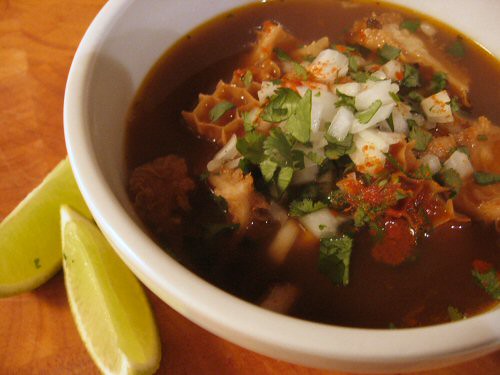
Menudo by scaredy_kat
Traditional cultures knew the value of foods that stretch resources and can provide nourishing food even when the stores are low.  Dried grains, root crops, fermented vegetables, hard cheeses and soups are the staple foods of most European cultures and the winter foods of Asia and North America are similar. The hearty soups that people across the globe eat during hard times to keep nourished and elevate into high cuisine in the good times are all based on one important food source - animal bones. Chinese egg drop soup, Korean gomguk, Thai tom yum, Norweigian cabbage soup, Russian shchi, Irish mutton stew, French onion soup, Mexican menudo and Cherokee pepper pot stew are all traditional soups that start with animal bones and end with a warm, nutritious meal perfect for late winter. In the Cherokee calendar, this month of the year is called the Bone Moon. I think that is fitting.

I make stock out of chicken, beef and whatever other bones make their way through my kitchen on a regular basis. I collect bones, both raw and cooked, along with vegetable scraps in a plastic zip bag in the freezer and make stock when I have about a gallon of scraps. The stock can simmer for a few hours, or a few days before you have to deal with it again, and the finished stock can stay in your fridge for a few days or your freezer for a few months. We use it to make soup, stew, polenta, rice and many other dishes that are infinetly more delicious and nutritious when made with home made stock. In fact, last weekend, my sister made a most delicious white bean and kale soup with homemade stock. 

*** *** *** 

Home Made Bone Stock
1/2 -1 gallon of assorted chicken, pork, beef or other bones (use mostly chicken, with some others... for beef stock see these instructions)
4-6 cups of assorted vegetable scraps from carrots, onions, garlic, celery, mushrooms or other non-cruciferous (cabbage family) vegetables
1 onion, cut in half with skin (if not enough onion in the veggie scraps)
2-4 cloves of garlic, smashed with skins (if not enough garlic in the veggie scraps)
2 tbs cider vinegar or 1/4 cup white wine1 tsp whole pepper corns
1-2 tsp salt
fresh or dried herbs including thyme, rosemary, sage or bay (optional)

Put the bones and veggies in a large stock pot (spaghetti pot or larger) and cover with cold water. Add the vinegar or wine and slowly bring the pot to a boil. If your bones are frozen, you can turn the heat to medium until everything is defrosted and warm, then up to high to boil. As it comes to a boil, skim any foam that rises to the top off and discard (don't skim too much fat off if you have it on top of the pot, that's good stuff!). Add the salt, peppercorns and optional herbs. Put a lid on the pot, turn the heat down to low or medium low to maintain a slow simmer.

Kale and White Bean Soup by little blue hen
Chicken stock is ready to strain and use after 4-6 hours, but can also be cooked considerably longer. I often simmer for a few hours, put the lid on and turn the heat off, then bring back to a boil and simmer again the next day. I've never gotten sick, yet, but if you are worried, just strain and refridgerate your stock whenever you are done letting it simmer. I strain my stock through a colander with or without a wire sieve in it (depending on how lazy I am feeling - I don't mind a cloudy stock) and pour it into various sized plastic containers to go into the freezer. 

White Bean and Kale Soup
2 quarts home made chicken stock, or a mix of stock and water
2 tbs olive oil, chicken fat or bacon fat
1 linguica sausage, chopped
1 onion, chopped fine
3 cloves of garlic, sliced, chopped or pressed
2 tsp red pepper flakes
1 tsp Italian seasoning
Salt and pepper to taste
1 can white beans, drained and rinsed or 2 cups homemade white beans
1 quart of kale, trimmed and chopped 
1-3 tsp lemon juice or cider vinegar

In 4 quart soup pot, heat the oil and fry the linguica until it has rendered it's fat and is starting to brown. Add the onion, pepper flakes and Italian seasoning along with some salt and pepper. Fry until the onion is soft and golden and add the garlic, frying another minute or so until fragrant.

Add the chicken stock and bring to a boil. Lower the heat to a simmer and add the white beans and kale. Cook for at least 10 minutes or until the beans are hot and the kale is wilted and soft. Adjust the seasoning with salt, pepper and lemon juice. Serve with cheese toasts, croutons, sauer kraut or whatever garnishes you like on soup. 

*** *** ***

Every Jewish grandmother knows that chicken soup will cure what ails you, from colds and flu to a broken heart or wrinkley face. Modern science is piling up more and more evidence that she is right. The connective tissue in bones and carcasses is full of gelatin and other nutrients that support healthy bones, joints, skin and hair. Gelatin is also a very nutritious and soothing protein that people of all ages and health levels can digest. Bone marrow, the fatty middle part of long bones, is an especially nutritious food that might support immune function but definitely supports a delicious meal. You can ask your butcher to cut long bones into
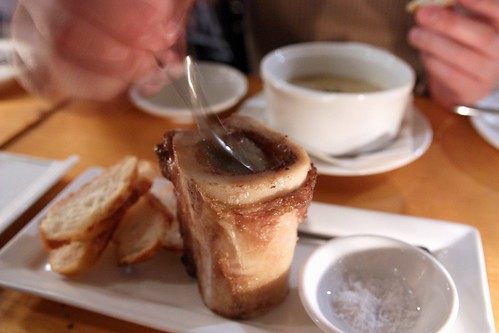
Silky Healthful Fat by Sifu Renka
2-3 inch slices, roast the bones and then pull the marrow out and spread it on toast. The marrow course was the highlight of my sister and I's recent trip to a fancy restaurant in downtown Portland. 

In addition to being good for the body, making stock is good for the soul and spirit, too. It is recycling at it's best and a truly respectful way to treat the animals we use for food. Bart Everson speaks eloquently of this transformation and what it means to him on the blog Humanistic Paganism. I know, too, that there is magic in taking the leftovers, the scraps and the ends and turning them, through long simmering, into a wonderful elixer of health and flavor. This can be a hard, hard time of the year especially if we are disconnected from our community and support. Using ancient and wise techniques like fasting, sharing or making bone soup reminds us that we do have the resources to nourish ourselves and each other, even when it looks like all we have is a picked over plate. 

How do you nourish yourself and your community during this dark time of late winter? Do you make stock at your house or have any memories of a lovingly made soup? What other recipes do you like for turning leftovers and left-behinds into loving nourishment? Do you prefer tom yum or french onion soup?

**** **** **** **** **** **** ****

Full Milk Moon 2009: Nourishing Self As Well As Others

Full Milk Moon 2010: The Full Wolf Moon

Full Milk Moon 2011: The Positive Feedback Loop of Love

Check the recipes and soup tags for more posts with yummy food. 

** This winter was tough and I got messed up in my calendar. I wrote this thinking it was the Fasting Moon but it was really the Milk Moon. Since the post itself is more about the the Bone Moon, I just changed the tags and labels. For more on my thoughts about this, see this post. **

Saturday, January 2, 2010

New Year!

This year the full moon in the Birth Moon in this year happened to fall on New Years Eve of 2009. I didn't get to see the moon, it was a wet, cloudy, drizzly night here in Portland, OR, but my flickr friends all over the world captured some amazing photos. Not only was New Years eve a full moon, it was a blue moon, or the second full moon in a calendar month. It was also a partial lunar eclipse (not visible in the Western Hemisphere) and a magically powerful moon by all other measures. My friend Riana from the south of France wrote eloquently about the magic of this moon here.


Photo by Bourbon Familia.
Magic is all around on a night like New Years, isn't it? I was out with friends, surrounded by love, liquor and music ringing in 2010 with style. The evening was auspicious, especially considering we hitched a ride home in a stretch hummer limo! I woke up in the morning feeling much better than I had expected (also auspicious!), had a fantastic breakfast with friends, got my change in two dollar bills (!) and went home to make black eyed peas and greens. How can 2010 not be fantastic?

Early on New Years morning (well, not THAT early, but early) I was laying on my friend's couch, listening to the sounds of the city, when a thought came to me about time. What is it that makes this day special? On one level, nothing makes it special. By any objective measure of time this sunrise is exactly the same as yesterday's sunrise. Different cultures all over the world celebrate the "new year" in different seasons - the Celts celebrate in the late fall/early winter, the Jewish calendar starts in the early fall/late summer, the Chinese calendar starts later in the winter and many cultures celebrate a new year in the spring. Our New Year right after the solstice is a hold over from the Roman calendar, and like our day, week and month labels is all pretty arbitrary.

At the same time, the day is different. It is special and unique. We have declared it unique and celebrate that uniqueness as a community. This is why I am so interested in integrating my practice of following the Wheel of the Year with "the real world". I don't want to celebrate by going out into the woods, naked and alone and worshipping a deity (though woods, alone and deity are all important parts of my practice, and can be very fulfilling for other people). I want my celebrations to include my friends and family who maybe have not thought about spirituality the way I have, or not come to the same conclusions. And that communal celebration is a strong kind of magic.

*** *** ***
Ring Out, Wild Bells
by Alfred Tennyson (England 1809-1892)


Ring out, wild bells, to the wild sky,
The flying cloud, the frosty light:
The year is dying in the night;
Ring out, wild bells, and let him die.

Ring out the old, ring in the new,
Ring, happy bells, across the snow:
The year is going, let him go;
Ring out the false, ring in the true.


*** *** ***


I followed my tradition of eating black eyed peas and greens for dinner on New Year's Day but cooked the peas differently this year than last. I made some goals and reflected on the year and went to bed early ready to face the new year. What bells did you ring to celebrate the New Year? How do "secular" celebrations fit into your spiritual practice? Did you make beans and greens this year? Oh.. and just because I didn't have another photo to post, here is one of me and my dog Tumalo sometime close to the Full Birth Moon.


P.S. I have been thinking about trying to come up with a non-number naming scheme for YEARS to compliment the seasonal names of the moons. In one of my favorite kids books, Redwall by Brian Jaques, the animals that live at Redwall Abbey name the years after events that happen such as The Year of the Late Rose, or The Year of The Giant Perch or some such. Do any of you have any thoughts on naming years? Have you ever named a year? What would you submit for 2009? For 2010?

Saturday, January 3, 2009

New Milk Moon

Last week was the new moon of what Annette Hinshaw calls the Milk Moon. Usually the Milk Moon begins later in January and the earth would be reflecting the first struggles of a new baby to grow and thrive. This year the Milk Moon began just before the new year and though we recently had 10 inches of snow melt overnight the earth is still deeply in the grip of winter. For a minute it felt like a false spring because of the green emerging from beneath the snow. False it was, though, seeing as nothing is growing and everything is still flattened by the ice and snow.

Right on the heels of solstice and Christmas comes another winter holiday that fell in the Milk Moon this year - New Years! Our New Years Day, celebrated in deep winter, is more a Roman custom than a Northern European pagan custom, but it's a rowdy fun holiday none the less. As is usual for Americans I went out with friends, enjoyed more than my fair share of alcoholic drinks and spend the first day of 2009 sleeping it all off. Happy New Year!

There are lots of traditions that are supposed to bring luck for the new year. All of my favorite, of course, include food. Hoppin' John is a traditional New Year's dish of black eyed peas or field peas and rice cooked with various pork products. It is indigenous to the African American cuisine of the southern U.S, the Carribean, Central America and Northern South America; everywhere Africans were brought as slaves to the New World.

Beans are a traditional New Year's food in Europe as well as America. The Italians eat lentils and both cultures claim that the little round beans look like money. Eat a bowl of beans on New Years Day and your coffers will be full all year. In the American South greens like collards accentuate the magic - a big pile of green is welcome all year round :) On New Year's day I made an easy stovetop version of Hoppin' John and a big pile of curly kale. It was easy, delicious and pleasantly warming on a cold, rainy night.

Stovetop Hoppin' John
Serves 3 or 4
*1/3 cup diced ham1 slice of bacon, diced
*1/2 onion, diced
*2 cloves garlic, pressed
*1 1/2 cups long grained rice
*3 cups liquid - water and/or chicken stock
*1 can of black eyed peas
*salt, pepper, dried thyme
Satuee the ham, bacon and onions together in a 2 or 3 quart pan with a lid until the bacon has rendered it's fat and the onion is soft and starting to brown. Add the garlic and thyme and sautee a minute more. Add the rice to the pot and sautee until the edges of the rice turn transluscent, or just a minute or two.
If the bottom of your pan is quite dark with carmelizing pork add just a little of the liquid at a time and scrape the browned bits off the pot. Otherwise, add the liquid, stir to combine and bring the whole thing to a boil. Add a little salt (be careful, both the ham and the bacon are salty) and black pepper then cover and turn heat to low.
When the rice is mostly cooked, in about 10 or 15 minutes, gently stir the peas into the rice mixture. Canned black eyed peas are quite soft so I had to literally fold them in. Taste and adjust salt then put the lid back on and let the rice heat up the beans. Make your greens while this is happening. Enjoy with some hot sauce or more black pepper.

Steam-Sauteed Hearty Greens
*1 bunch of curly kale or collards or mustard greens
*2 cloves garlic, sliced
*1 tbs bacon grease plus a little olive oil
*a shake of red pepper flakes
*a pinch of salt
*a dash of red wine vinegar
Clean the kale and remove the leaves from the stem. Chop or tear the leaves into fork sized pieces. Heat a couple inches of water in a pan big enough to hold all of the kale. When it is boiling add the greens, stir a bit with a wooden spoon or tongs and cover. Let the kale steam a minute up to five then drain in a colander. While the kale is draining and drying a bit heat the fat in a sautee pan or wok. Add the garlic and red pepper and cook until the garlic is starting to brown a bit. Add the kale and toss and turn with tongs. Cook until the kale is fully incorporated with the flavored oil. Sprinkle with salt and then finish with vinegar.

The time right after New Year's Day is a time for reflecting and thinking about plans for the upcoming year. 2008 was a great year. I have had wonderful times and learned so much. 2009 will just get better :)

What did you do to ring in the New Year? How is 2009 going to shape up for you? What's your favorite way to cook greens? :) Happy New Year and may we all have our bowls overflowing and our greens piled up in 2009!