Showing posts with label Bible. Show all posts

Sunday, December 28, 2014

Open Worship, a Quaker Distinctive

This was written as a first word for my Quaker community, West Hills Friends. First words are a 3-5 minute report on how god is moving in your life right now. 

*** **** *** **** *** **** ***

Hello, my name is Alyss and this Christmas was my fifth Christmas at West Hills. I didn't grow up a Quaker but last summer, a Friend here accused me of "being convinced by the process". I laughed but have come to think of that as the best way to describe my Quaker conversion. This process, these centuries old methods of seeking and finding, these are distinctive ways of worship and business particular to us Quakers. I've seen them work and they have convinced me. 

George Fox wrote, "Meet together, and in the measure of God's spirit wait, that with it all your minds may be guided up to God, to receive wisdom from God. That you may all come to know how you may walk up to him in his wisdom."

Here at West Hills Friends we hold our open worship to be that special and sacred place where we wait for God's spirit. And more than once, I have received some of that wisdom Fox referred to. Sounds like it would be fun, right? Hah. Being led to speak in Meeting is not, in my experience, an altogether pleasant experience. I like to talk and I like to tell people what I think and know. I mean, I'm a middle school teacher - I make a living standing up in front of big groups of people telling them what I know. But giving vocal ministry is not like that at all.
  
Silent worship is, in our Quaker understanding, a time for God to speak to us. God is speaking to us, her gathered body. God has always had to use humans' hands, mouths and wombs to do her work and through generations of lived experience we have learned that silence together is one of the best ways to prepare for hearing that voice of god. That silence is important, it is sacred, it is the path we walk on to get to the place we can hear god. And maybe be asked to share what we hear.

In 1659 early Friend, Alexander Parker wrote about giving vocal ministry: "And if any be moved to speak words, wait low in the pure fear, to know the mind of the Spirit, where and to whom they are to be spoken. If any are moved to speak, see that they speak in the power; and when the power is still, you are still."
 
Pure fear. Speak in the power and when the power is still, you are still. This is not a small task we are being called to. Silent worship has always seemed to me as akin to us all being archaeologists working on a dig. Each person is intent on the delicate work right in front of them. Giving vocal ministry is like yelling "Look - look what I found!" Everyone stops their own work with tooth brushes and dental picks to see what you found. If what you've found is good it will help everyone else with their work. But there's a chance that you are distracting them and interrupting their good work.

In my experience, being called to speak in worship is a distinctly physical experience. It starts with a thought, just like any other thought, but almost immediately there is a distinct bell that DINGS in my mind. A flag that this is important. So, my mind reacts to this notice of importance with "Oh! I should stand up and share!" But then I get a kind of sense of dread. Nope, that's just my ego talking, wanting to be seen and heard and have people think I'm witty and wise and clever. That is not what this time is for. So I sit, listening again.

Edward Burrough, an early convert under Fox wrote in 1655 "Do not be hasty, when you see things open in your minds; dwell in them, and do not run out to speak them, but treasure them up in your hearts, and take heed, and keep low in the fear of the Lord God, that pride and presumption do not get up, nor anything be exalted above what is pure."

Often, at this point, that original thought expands, contracts, continues on to something else that feels different than my own thinking and again the bell DINGS. By this time, though, the No often comes from my ego... "I am so not standing up and saying THAT". What before felt like a message that would get me applauded now feels like a message that would bare my innermost tender and gooey parts. I am not saying that out loud. At about this time my stomach starts to hurt and my knees feel weak. Denial on the edge of panic. No no, no. But the message won't go away and by now it is clear that god has tapped me on the shoulder to say this thing. She's waiting, standing behind me with my arms crossed waiting, like Yahweh listening to Moses give all the reasons he can not possibly go talk to Pharaoh, both of them knowing full well Moses is gonna go talk to Pharaoh.
 
Other people speak and I am temporarily relieved. Sweet, off the hook! But then the silence falls and I'm back on that hook. Finally I can't stand it. The pressure is too much or Mike asks if "all hearts are clear" and mine most certainly is not. I stand and start to speak. The first few words are familiar, I thought these already. But often the message moves away from my thoughts and things that had been nebulous at best come out in elegant or halting words. People often thank me for these words but I feel bashful - they weren't mine. I didn't think them, I hardly remember speaking them. When the message is done I sit down and thank goddess for whoever it was that donated those pillows 'cause I really need to hug something to me when I sit back down. The first time this happened I remember thinking, "oh! That's why we're called Quakers."

Giving vocal ministry in open worship is a Quaker distinctive. It is a thing that sets us apart from other people, other Christians, other seekers. I don't know if this is how vocal ministry works for yo, and this is not how god works for me in most other places in my life. It is a mystery and I have no explanation. I am convinced by the process, though.


Quotes from Early Friends came from Hall V Worthington's website here: http://www.hallvworthington.com/George_Fox_Selections/meetingrules.html

Sunday, March 2, 2014

Evolution Sunday

New Seed Moon 

**** **** **** **** **** **** ****
 
I was asked to give the message at my Quaker church for Evolution Sunday 2014. This is usually celebrated the second weekend in February in honor of Charles Darwin's birthday but a rare Portland snowpocalypse postponed it until the first weekend in March. Here is what I wrote. What I said was slightly different, but for details and impressions from the gathered crowd you'll have to ask someone who was there. Enjoy!

**** **** **** **** **** **** ****
It is interesting to contemplate an entangled bank, clothed with many plants of many kinds, with birds singing on the bushes, with various insects flitting about, and with worms crawling through the damp earth, and to reflect that these elaborately constructed forms, so different from each other, and dependent on each other in so complex a manner, have all been produced by laws acting around us..... There is grandeur in this view of life, with its several powers, having been originally breathed into a few forms or into one; and that, whilst this planet has gone cycling on according to the fixed law of gravity, from so simple a beginning endless forms most beautiful and most wonderful have been, and are being, evolved.
Charles Darwin's The Origin of Species, Chapter 14, Concluding Remarks

Today is evolution Sunday, a day when we reaffirm that science and religion or spirituality are not enemies but both ways that we humans find meaning in a world that all too often seems meaningless. I have always been a nature girl. My mom took me and my friends out on nature hikes all around the San Franscisco bay area from the time I was very little and there was always a sense of awe and wonder in those natural places. From climbing on redwood logs as tall as a house to catching newts and bugs in creeks and playing in the ocean, I was always most happy outside. As a teenager I spent hours wandering by myself through the forested parks in this neighborhood and my sense of wonder grew as my awareness and understanding grew. My studies of natural history and science in high school and college led to some of my first explicitly spiritual experiences - laying on a log overwhelmed with awe at xylem and phloem one year, stunned at the intricacies of the body systems of the starlings flying above me another year, grinning with joy and awe at the migrating vultures overhead another year. I watched the moon and saw the face of god there. I climbed mountains and swam in rivers and studied the workings of the earth and her inhabitants and I was in awe.


Like so many students of science before me I found wonder and awe in the theories that scientists have used to explain and understand the world, too. Mathematicians and physicists often describe equations as beautiful and I don't quite get that, but I do see stunning beauty in Darwin's Theory of Evolution by Natural Selection. It is beautiful because it is simple, but out of that simplicity comes immense variation and flexibility. It is beautiful because it is based on observed evidence and it is beautiful because it allows me to make some sense out of an otherwise rather senseless world. 

The theory of evolution by natural selection says that over time populations of organisms change because some of the organisms have heritable traits allow them to survive more easily and thus have more offspring. A classic example of this is the story of the peppered moth, a standard sort of moth found in England. The typical variety seen before the Industrial revolution was a pretty white grey with some darker specks, allowing the moth to blend in perfectly with the white grey and speckled tree bark and lichen found in its forest home. As coal burning became more prevalent during the Industrial revolution the trees in England became stained with soot, making the pretty white grey with speckles colored moths easy targets for the birds who wanted to eat them. Luckily for the moth population, some small number of moths were born with darker wings and they blended in well with these new, darker trees. In recent decades, with stricter air quality standards and cleaner trees, the lighter speckly variety is again more common. Other classic examples of populations that change because some traits are more adaptive that we all know and love are things as mundane as dog breeds and as important as antibiotic resistant bacteria.

Evolution by Natural Selection is beautiful because it is simple, but out of that simplicity comes immense variation and flexibility. It shows a biological universe where just a few simple rules, carried out with novelty, creativity and fecundity, lead to stable ecosystems where every creature's needs are met. The rules of natural selection really basic: gather enough food and evade becoming food long enough to create the next generation. The ways creatures fulfill these rules are staggeringly varied and the results it allows for are mind boggling. Dandilions grow in any patch of soil and quickly flower, sending out millions of seeds on fluffy parachutes into the world in the hopes that just one or two will survive. Coast redwood trees, however, don't even begin to produce seeds until they are 10 or 15 years old and only about 15 percent of those seeds are viable. Cheetahs and antelope have honed each other into lean running machines though countless generations of "arms race" competition. Slightly less fast antelopes get eaten by slightly more fast cheetahs while slightly less fast cheetahs are outrun by the slightly more fast antelope. Each generation slightly faster than the last until we find in the plains of Africa today these amazing creatures. Sometimes the sheer number of types and individual living things overwhelms me. We get blase about it but our entire planet is covered in living things. Grass and weeds, ants and bugs, sea gulls and pigeons. There is so much variety of life. All I can do some days is gawk in awe.


Evolution by Natural Selection is beautiful because it is based on observed evidence and it is beautiful because it allows me to make some sense out of an otherwise rather senseless world. Charles Darwin spent twenty years studying and compiling evidence for his theory and scientists have spent 150 years continuing that work. Darwin himself saw evidence for evolution by natural selection in the distribution of species such as his famous finches in the Galapagos islands, in fossils and in the comparative anatomy he studied for most of his adult life. The story told in every biology text book of the bones in the forelimb of mammals is classic for a reason - my human hand has the same bones as the flipper of a whale, the wing of a bat and the paw of a cat. Common descent with modification explains that fact in a simple, logical, sense making way. North American paleontologists have discovered a well preserved series of fossils showing the change over time of a little forest dwelling leaf eater with four toes into a large, grassland dwelling single hoofed and long necked horse many of love today. Not all lines show such well preserved evidence, but exciting discoveries in fossil whales and feathered dinosaurs support the theory with evidence. Darwin knew nothing about genetics but we know lots about the biochemical mechanisms of inheritance today, and all of it shows that vastly different kinds of living things are related to each other. People talk about "believing" in evolution but that seems to me completely besides the point. It's not a matter of faith to me, it is simply the best explanation for the evidence observed. Every new way we question nature with scientific methods we see patterns of common descent and patterns of change in populations over time due to environmental pressures. I have to believe that scientists know what they are talking about, but scientific thinking provides evidence for conclusions. The overwhelming variety of life on earth makes sense when we understand evolution. There is a pattern, there is order in this chaotic complexity. And that is beautiful.

The theory of evolution by natural selection is beautiful because it is simple, but out of that simplicity comes immense variation and flexibility. It is beautiful because it is based on observed evidence and it is beautiful because it allows me to make some sense out of an otherwise rather senseless world. I see in our Quaker community a similar, beautiful system of variety out of simplicity and order out of chaos with evidence to support it. 

Here at West Hills I see a system of just a few rules carried out with creativity and novelty that lead to a stable system with room for all who want to be here. We don't have a long list of rules rigidly enforced to keep the good from the bad, we let the equilibrium of the system that is in touch with it's source do that heavy lifting for us. Our rules really are few: the Inward Teacher is within every person, listening for that Still Small Voice together allows us better access than seeking alone, and we must love each other and God in the same way for they are the same thing. In this very room right now we have people who have widely varying beliefs about the figure of Jesus Christ, about the best ways to live a moral life and the best way to sing Happy Birthday. But all of us together make for a forest full of variety and adaptability. 


I also see at West Hills a system of practice based in the evidence of what actually works. George Fox, in his journal, told of his first opening to understanding that the spirit of god could speak directly to his condition. He finished his report with the words "and this I knew experimentally". He had tried listening to the priests and the preachers, he had examined the paths of soldier and tradesman and none gave him the peace and understanding he sought. But listening to his inward teacher, "who enlightens, and gives grace, and faith, and power" worked, he had evidence for a fruitful path. The earliest of Quaker advice and queries such as the Balby Letter of 1656 admonish Friends to gather regularly and "speak the word of the Lord at such meetings, that it be done in faithfulness, without adding or diminishing". They reminded each other to care for those in need in their community and "all be subject one to another, and be clothed with humility". These weren't rules just to be followed because those 17th century Friends liked rules, they were advice given based on what they had experienced to work. They saw in their meetings that Friends who spoke the words of the Lord clearly and faithfully contributed to the life of their meetings. They saw that taking care of each other, walking with humility and grace and being discrete in their confrontations of straying Friends made their lives together better and made it easier to hear those words of the Lord. Quaker practice is an evidence based practice. I don't need to take it on faith that it will work, I've seen it work for four years and three centuries of Friends before me have seen it work. And that is beautiful.

The theory of evolution by natural selection is beautiful because it is simple, but out of that simplicity comes immense variation and flexibility. It is beautiful because it is based on observed evidence and it is beautiful because it allows me to make some sense out of an otherwise rather senseless world. Quaker practice is beautiful because it is simple, but out of that simplicity comes the adaptability to accept all who want to come. It is beautiful because just as George Fox before us "knew it experimentally", we see the fruits of our work, we see evidence for our best practice. And that is pretty darn beautiful.


What do you see in the human life of the mind as beautiful? What is your experience with waking up to the beauty of the natural world?

Where in Quaker practice do you see flexibility and adaptability coming out of simple rules? How has Quaker practice taught you, experimentally, to hear the still small voice?

What signs of spring are showing you the beauty of life all around us? 

**** **** **** **** **** **** ****

New Seed Moon 2012: The Seed Moon

New Seed Moon 2011: Johnny Appleseed (one of my all time favorite posts!)

New Seed Moon 2010: To Everything there is a Season

New Seed Moon 2009: The Seed Moon Is New 

Also, check out my other posts labeled Quaker for more I've written addressed to and about my Quaker community.


Sunday, July 15, 2012

Nothing But Good Can Come of This

Mothers Moon

**** **** **** **** **** **** ****
The Story of the Lost Son
Then he said, "There was once a man who had two sons. The younger said to his father, 'Father, I want right now what's coming to me.'
"So the father divided the property between them. It wasn't long before the younger son packed his bags and left for a distant country. There, undisciplined and dissipated, he wasted everything he had. After he had gone through all his money, there was a bad famine all through that country and he began to hurt. He signed on with a citizen there who assigned him to his fields to slop the pigs. He was so hungry he would have eaten the corncobs in the pig slop, but no one would give him any.

"That brought him to his senses. He said, 'All those farmhands working for my father sit down to three meals a day, and here I am starving to death. I'm going back to my father. I'll say to him, Father, I've sinned against God, I've sinned before you; I don't deserve to be called your son. Take me on as a hired hand.' He got right up and went home to his father.

"When he was still a long way off, his father saw him. His heart pounding, he ran out, embraced him, and kissed him. The son started his speech: 'Father, I've sinned against God, I've sinned before you; I don't deserve to be called your son ever again.'

 "But the father wasn't listening. He was calling to the servants, 'Quick. Bring a clean set of clothes and dress him. Put the family ring on his finger and sandals on his feet. Then get a grain-fed heifer and roast it. We're going to feast! We're going to have a wonderful time! My son is here—given up for dead and now alive! Given up for lost and now found!' And they began to have a wonderful time.

 "All this time his older son was out in the field. When the day's work was done he came in. As he approached the house, he heard the music and dancing. Calling over one of the houseboys, he asked what was going on. He told him, 'Your brother came home. Your father has ordered a feast—barbecued beef!—because he has him home safe and sound.'

 "The older brother stalked off in an angry sulk and refused to join in. His father came out and tried to talk to him, but he wouldn't listen. The son said, 'Look how many years I've stayed here serving you, never giving you one moment of grief, but have you ever thrown a party for me and my friends? Then this son of yours who has thrown away your money on whores shows up and you go all out with a feast!'

"His father said, 'Son, you don't understand. You're with me all the time, and everything that is mine is yours—but this is a wonderful time, and we had to celebrate. This brother of yours was dead, and he's alive! He was lost, and he's found!'"

Luke 15:11-32 from The Message Bible

*** *** ***

 I've never been terribly fond of this story. I never understood why the brother who stayed wasn't celebrated while the brother who left got a party. It seemed so unfair. The light of the Mothers Moon this summer
 has allowed me to see the story, the Father's actions, in a different way. In the way of motherlove.

The Mothers Moon reminds us that we are all worthy of love not based on what we do or believe or say, but based simply on the fact that we exist. We are the Mother's beloved child and she will love us no matter what we do or don't do. The Father in the parable of the Prodigal Son loves the boy who left and came back just as much as he loves the son who stayed. Both are beloved sons, both are deserving of barbecues and dancing. Neither deserve punishment or chastisement.

I think in the past I have always identified with the son who stayed. Of course I was the child who who played by the rules, didn't strike off on my own, didn't do dumb or silly things. Worked hard, played it safe. No one would ever have to throw a party for me when I returned, because I would never leave. This spring, however, I have done some "leaving". I like to think that I have been splashing around in the shallows of hedonism for a couple months. I have felt far from some aspects of my spirituality, 
especially my contemplative practices,  but I have never felt far from the spirit of god. I have felt a bit like the kids I took to the beach last week; they ran and screamed and poked dead things and climbed on things while I watched from the sidelines. They might have gotten hurt, but that is part of growing up. I might have gotten hurt or distracted as I splashed around in all this emotional and physical muck, but the Goddess is near by to comfort me when I scrape my knee or bang my head.  She loves me no matter what I do, or don't do.

The epiphany that came right around the full moon of the Mother's Moon rang so true with pronoic motherlove energy: Nothing but good can come of this. She loves me no matter how prodigal I am. 

**** **** **** **** **** **** ****

Mother's Moon 2011: Freedom, July and Krishna and the Gopis


Mother's Moon 2009: Gifts from the Mother

Tuesday, February 28, 2012

Realigning


 New Fasting Moon

**** **** **** **** **** **** ****

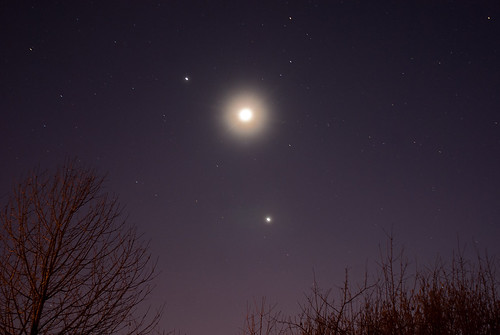
Have you seen the moon these last few nights? We're a week into the new moon and it has been a lovely little crescent hanging in the western sky in the early evenings. I had a rough day at school early this week but when  I walked out of the building at 5pm, I saw the fingernail moon peeking out from between some fluffy clouds. I watched it all evening as I drove home and took the dog for a walk and it was like a beacon to remind me of the beauty of the day even in the midst of all the hard. Last night I was treated to an even better show; the crescent moon and two bright planets! Venus and Jupiter were shining out the haze of an
by Pierre J.
approaching storm. Apparently, Venus and Jupiter will be getting closer and closer together as the month goes by and Mercury can be seen right behind the setting sun, and soon Mars will be visible rising in the East in the early evenings. What a great way to start a month!

As I was preparing to write the blog post I went back to review my posts from the winter and read the chapter in Annette Hinshaw's Earth Time Moon Time for the upcoming month. I couldn't figure out why the months in the book weren't lining up with the months in my blog and then I realized - I messed up my calendar! Sometime during the Sorting Moon I skipped a month and have been off all winter. When I thought it was the Birth Moon it was really the Death Moon. Eep!

To fix the mess I reviewed all my posts and decided which I could just put new tags on, and which I needed to just call a mess and leave it at that. All the posts that are tagged incorrectly or talk about a month that is not the actual month it was written in are now labeled with the tag "wrong moon." 

by meglet247
Besides being embarrassing that I messed up, this situation brings to the forefront the question of how real are the moon energies anyway? I just saw a video of Bill Nye discrediting astrology by invoking the fact that the axis of the earth has wobbled in the last 3,000 years. This means that the sun rise on your birthday is in a different constellation than your astrological sign. That is true, but it discounts the non-material truth of the astrological archetypes. Being a Virgo is a way of thinking about the complexity that is my personality and life, not some material truth like the fact that every gold molecule has 79 protons or water freezes at 0 degrees centigrade. The moon energies of Annette Hinshaw's calendar are archetypes too, not astronomical truths.

This winter I had a really rough time with school and student teaching. I had to do a lot of searching in the deep truths of my moral and theological universe to find ways to cope with the challenges I was facing. The archetype of the Birth Moon, a time when the new year is very young and faces all the challenges of a new born baby, helped me find some meaning in my own challenges. Does it matter that the time I was going through these challenges was actually the Death Moon? My answer is no, it does not. 

Archetypes, myths, stories and images are tools for thinking that are not strictly aligned with the physical, material world. Would it have mattered if I looked to tarot or Sabian symbols instead of moon energies? What if I'd been looking at the Parables of Jesus or Koranic suras for my inspiration? Can you only look at the story of the passover during the spring and it holds no meaning at other times of the year? In my way of thinking, the moon energies are well aligned with the 
Earthrise, a NASA photo
seasons they occur in, like the passover story, but they are not rigidly linked. The story of Yaweh choosing his people and letting his plague pass them over is a powerful one, even when you tell it in the deep winter.

So, yes, it's disconcerting to think that I was getting ready to celebrate the spring joy of the Seed Moon when in fact I have a whole Fasting Moon to get through. I have never been fond of the Fasting Moon, but I guess that means I have some more work to do with these archetypical energies. It's leap day this week, a time for readjusting our thinking about time. I'll be readjusting to thinking about the Fasting Moon for another few weeks and letting spring creep slowly on instead of rushing full force into it. 

When have you made a mistake that made you think more deeply about what you were doing? When have you had to readjust your thinking about something? How have you been enjoying the astronomical show in the sky, or the botanical show starting to make itself known in the garden?

**** **** **** **** **** **** ****


New Fasting Moon 2010: Spring is Springing

New Fasting Moon 2011: The Nian

Saturday, October 1, 2011

C.S. Lewis on Praise

New Harvest Moon

**** **** **** **** **** **** ****


Before the loaf, the snowy white flour
Before the flour the mill.
Before the mill the wheat and the shower,
The sun and Our Father's will.

I have been reading a collection of C.S. Lewis essays called Reflections on the Psalms. I've read a few other pieces of Lewis' non-fiction work, letters and essays, and greatly enjoy them all. He and I may differ quite significantly in some aspects but I do love reading him. I would love to have him as a neighbor or great uncle to visit with, drink tea and listen to him ramble on about God and life and such.

In his rambling on about the Psalms he comes to the issue of praise of God. He says that he never used to understand the commandment to praise God or the way some people seems to be bargaining with God through praise. He finally came to a realization that praising god is the scaled up version of the praising we do of all good things in our lives. "It is frustrating to have discovered a new author and not to be able to tell anyone how good he is; to come suddenly, at the turn of the road, upon some mountain valley of unexpected grandeur and then to have to keep silent because the people with you care for it no more than for a tin can in the ditch. " We express our delight and enjoyment because that expression makes the enjoyment full. We delight and enjoy God and so can't help but exclaim that joy in words, songs and actions of praise.

Lewis makes the point that this praise is not only natural, but it is evidence of health. "The healthy and unaffected man, even if luxuriously brought up and widely experienced in good cookery, could praise a very modest meal: the dyspeptic and the snob found fault with all." A healthy attitude towards life leads to praising earthly experiences so a healthy attitude towards the divine would equally lead to robust and genuine praise of God. The question I have, though, in light of this current Harvest Moon, is which is the seed and which is the harvest? The healthy attitude or the genuine praise?

For our daily bread we thank the Father
We thank the sun and the moon and the stars
We thank the wind and the frost and the rain
We thank the earth, we thank the grain
The thank the beasts and all farming men.

I have been thinking a lot about gratitude, complaining, cynicism and acceptance lately. I've been more and more annoyed by negativity I see in people around I have been making an effort to not take part in that talk or thinking myself. I made a New Water Year resolution to not complain about the weather, a resolution I joke will lead me to an abnormally high level of complaining about my clothes. But then I think, clothes are something I can change so it's OK to critique them, the weather is not. Many great thinkers from Gautama Buddha to Viktor Frankl to Thomas Jefferson have said that attitude is the key to a fulfilled life. There is a space between what happens to us and how we react and in that space we make a decision about how we will react and what we will believe about the action. This is a space for optimism, for gratitude and for god.

I still wonder, though, which is the seed and which is the harvest? Do we have a steady bearing in the world because we make space for gratitude and praise in between events and reactions, or does a good attitude cause the space to open up? Maybe, like so many other complex systems, it is a matter of both elements playing a part. We nudge the system from whatever part of it we happen to be standing at in the moment - giving thanks when we want to complain, or inserting praise into the space we feel at the moment in between.

The seed and root beneath the earth,
The willful growing shoot,
The hopeful bud and flow'ring blossom
Turned to glowing fruit.
We thank the earth who grew this food from little bursting seeds,
And the keepers of the earth whose gifts fulfill our needs.

What harvests are you celebrating this month? Are you seeing a harvest in attitude, thanksgiving or relationship with god or is that a future harvest you are sowing for now? How is your garden winding up? Have you found any fruit trees in the neighborhood or great deals at the green grocer? How do you give thanks when you really just want to complain?

**** **** **** **** **** **** ****

New Harvest Moon 2009: The Harvest Moon is New

Apparently I didn't post a New Harvest Moon post in 2010, but I did post Harvest Moon during that month.

Monday, September 26, 2011

Michaelmas Season

Autumn Equinox

**** **** **** **** **** **** ****


The season is swirling around and I am feeling very caught up in it. I love the ride, the golden light, the crisp mornings and hot afternoons, the change in birdsong and the ripening fruit, but I am also feeling pushed and pulled all over the place. I haven't found my new grip yet. Must be the turning of the wheel into autumn.

Autumn is my favorite time of year. I love the cooler days, the yellowing plants, and the harvest. I especially love the comforting feel of the constricting energy that fall brings. In the summer, the Earth is in the height of its long outbreath. It's soul is expelled fully out to outer reaches of it's atmosphere, touching the cosmos. This gives those of us on the surface energy and freedom. We want to be outside, live outside, be up early, stay up late, run and play and swim and be in the world. I tend to feel a little frayed by the end of it all, like last season's prayer flags, faded and rough around the edges. As the earth turns towards the Winter, it begins to breathe its soul back in. This constricting energy makes me feel like I'm being given some more boundaries. A bed time seems like a reasonable idea. Sitting down to dinner instead of just grabbing some food on the run makes sense. Rebuilding the rhythms of a life that includes work as well as play, rest as well as activity. It's the back-to-school season in more ways than one.

Fall, Leaves, Fall

Fall, leaves, fall; die, flowers, away;
Lengthen night and shorten day;
Every leaf speaks bliss to me
Fluttering from the autumn tree.

I shall smile when wreaths of snow
Blossom where the rose should grow;
I shall sing when night's decay
Ushers in a drearier day.


-Emily Bronte

In my evolving wheel of the year, I call this time the Michaelmas Season. The story of Michael is one of a hero who harnesses heavenly and earthly powers to subdue and over come a primeval force of chaos and fear. There are many stories told about dragons and heroes this time of year and all of them help align us with this powerful movement of the seasons, both inner and outer.

My Quaker pastor, who's sermons are always a mix of hilarious and thoughtful storytelling, told a story this morning about a world plagued by a terrifying serpent. It lept out of the ground in a village, ripping up cobblestones, showering the area with rubble and dust, knocking people over and devouring the tinker's faithful mule. The villagers filled the hole in with rocks and logs, paved over the square and put up a statue to the mule. After a number of years the tinker was able to purchase a new-to-her mule and travel further afield selling her wares. She came upon a large city with towers and guards all around it. A friendly guard allowed her in and took her up on one of the towers to show her what the fortifications were all about. There were large cannons on each tower but instead of facing outwards, towards an enemy's army, the cannons faced inward, toward the town square. Specifically, facing the gaping hole in the middle of the square. The guard told her about the serpent and how the city had responded to the threat by building all these battlements. Everyone was expected to do their part in helping guard against the serpent threat, including a tax levied on traveling merchants and tinkers. The tinker owed, as it happened, exactly one mule.

In this time of year when we prepare ourselves for the coming darkness of winter we are also asked to prepare ourselves for the coming challenges of earthly life. There will be illness, poverty, pain, loneliness and eventually an end of this life. The story of the tinker and her mules mules reminds us that we can prepare for these inevitable burdens in any number of ways, some of which are actually more detrimental than beneficial. Michael provides us with heavenly iron to arm ourselves this time of year, but the real defense against debilitating fear is internal strength and courage. These things come from the dynamic interplay between God's love and providence, and our own willful building of our lives.

We wait in hope for the LORD;
he is our help and our shield.
In him our hearts rejoice,
for we trust in his holy name.
May your unfailing love be with us, LORD,
even as we put our hope in you.

Psalm 33:20-22, New International Version

I marked the Michaelmas with some of my favorite September activities. I put up my St. Michael and the Dragon mobile, watched the swifts at Chapman School and woke up for the sunrise on Equinox morning. I went again to my favorite fall fruit picking field and walked around as the sun creeped up behind Mt. Hood. I made dragon bread the night before, a new Michaelmas activity for me. Bread dragons are easy to vanquish and nourishing as well. At the field, I found a lovely pear tree in full fruit and happily accepted the gift. In prayer, I have been given the image of a pear tree, laden with full and heavy fruit hanging within easy reach, as an image of God's provisions available to me. Pears seem a perfect image for God's gifts. The fruit is earthy, woman shaped and sweet but bruises easily so must be conscientously picked and preserved. It is not a windfall treat.

As the sun came up, all pink and orange, over the misty autumn field I laid out my feast and said my thank yous. Thank you sun, thank you mountain. Thank you pear tree and grain field. Thank you morning and thank you evening. Most of all, thank you autumn!

How are you marking the turning of the wheel into Autumn? What dragons are you facing these days and how are you preparing to meet with them? Are your preparations costing you more mules than they need to? What's your favorite kind of autumn fruit?

**** **** **** **** **** **** ****

Autumn Equinox 2009: The Autumnal Equinox and
The Earth is Breathing its Soul Back In

Autumn Equinox 2010: Here Be Dragons and A Dragon Tale for Michaelmas

Monday, June 14, 2010

You Are The Mother's Beloved Child

The other night my cousin was in town and wanted to see the sunset from Council Crest, the higest point in Portland. The weather has been unseasonably wet lately so I wasn't optimistic about our chances for a nice sunset but the cloud cover broke just enough for us to see something besides rain. To the east was a solid wall of dark, red-purple rainclouds, like a curtain dropped between town and the mountains. To the west were fluffy blue clouds rimmed with gold and pink. Above those spectacular clouds was a new crescent moon. I don't think my cousin was as excited to see the moon as I was, but after close to 6 weeks of rain I have hardly seen the moon at all. Hello, New Moon! I'm glad you are back!

The new moon this month is the Mother's Moon which brings unconditional motherlove to all the myriad things. The Mother's Moon celebrates the energy of a love that is given simply because you exist. You are The Mother's beloved child; of course she loves you.

My cousin and I spent some really good quality time talking about our lives and our families during his visit this week. It was interesting to hear his thoughts about his father and stepmother and how little connection he feels with them. He says that even though his mother died when he was very young and his father and stepmother married before he started elementary school he has never called her "mom", only her given name. I contrasted this with my own family and am grateful for what I find. My parents did not have the ability to provide the material comforts my uncle was able to give his family, and from the outside we may look like a less loving family (my dad always half-jokes; "We stayed together for the kids, the screaming and yelling was good for them.") but I know my parents adore(d) me. I know my parents sacrificed their own wealth, their own dreams and even their own friends and relationships to provide my sister and I with everything they could. I have never for a moment, not even in the heat of our adolescent battles, doubted that my mother loves me more than anything in the world. And I am so, so grateful for that.

One of the easiest ways for me to conceptualize god is as an all loving Mother. I have always preferred a feminine pronoun for the divine, love the images of female goddesses of the world and find great strength in knowing that god adores and delights in me as a mother adores and delights in her children. At this time last year I wrote about a couple of my early influences in seeing god in this way and those influences are still strong in my relationship with the divine. The image of God as a mother big enough to hold and rock me, who showers me with gifts and loves me no matter what is comforting. I usually start my prayers with the address "Sweet Mother" in place of the more common "Our Father". I recognize that this isn't the only way to address god, or even always the best way, but it is what feels best to me, most of the time. It feels comfortable and safe. Motherly.


Motherlove, however, is not always comfortable. The Mother loves all her creatures equally and without regard to their merit. This means She loves murders and addicts (see this description of Gabor Mate's In The Realm of Hungry Ghosts: Close Encounters with Additions). She loves unscrupulous politicians and selfish executives. She also loves man-eating tigers, rip tides, blizzards and tornadoes. After the earthquake in Chile this last winter a friend of mine made a quip on Facebook about "Mother Earth just wants to get us off her back." I offered the idea that the earthquake didn't have anything to do with us. The Mother loves the planet and the physical processes of it's geology as much as she loves the billions of humans living on its surface. This is a much scarier idea to me. It's not that God/Mother Earth/Destiny has bad things planned for us, it's that we are rather insignificant in Her plans. Or no more significant than an earthquake.


Holding that juxtaposition of a God that love me specifically and also loves everyone and everything else just as specifically is a hard one for most people to grasp. People like to think of god as loving them so much that obstacles are removed from their path no matter what that means to other people or other beings. I just read the book of Joshua in the Old Testament and the people of Israel clearly worked within that paradigm. God promised them this land and they fought, slaughtered, burned and pillaged to get it. I just kept thinking about the poor people of Jericho and Ai and all the others. What part of God's love was shown in their slaughter?

This is a huge, HUGE question and one that I am in no way prepared to answer. I only have some ideas and some experiences to fall back on. At Meeting a couple weeks ago someone gave vocal ministry repeating the old saying "Never show a fool a work half done." I am the fool to God's work. Sometimes I have to give up thinking that I can know what form The Mother's love will take for all of her beloved. Just yesterday on my morning walk, while meditating on this post, I came across a robin's egg in the trail. It wasn't just the usual shell fragments you see this time of year, it was an egg with a fully formed but still embryonic chick, smashed and dead. Where is the Mother's love in that? That is not my question to answer. I just have to have faith that, as I feel and know Her love for me, that love is extended to all other beings sentient and otherwise. And in this glorious month of June, when the days are long and the garden is green, it's a little bit easier to remember.

Tuesday, April 6, 2010

Easter

Easter Sunday is the most holy day in the Christian religion. It is the commemoration of the day Jesus rose from the dead three days after his sacrificial crucifixion and is celebrated on the first Sunday after the first Monday after the first full moon after the Vernal Equinox (Rudolph Steiner spoke about how this festival falls when the calendars of the earth, the moon and the man-made week have all realigned themselves). This year that fell on April 4th. Some Christian groups celebrate a whole slew of holidays leading up to and following Easter including Mardi Gras, Lent, Palm Sunday, Good Friday, Ascension and others. It is a busy time in the Christian church.

I wrote some last year about the various spring celebrations from all over the world that cluster around the Spring Equinox. Much of what we see in modern Easter celebrations - Easter bunnies leaving candy, hunting for dyed eggs, wearing new dresses and hats, eating lamb or ham, even the name Easter - come from pre-Christian European spring celebrations. Much like with Christmas, the expanding church in ancient and medieval Europe co-opted the local traditions and reassigned them meaning in the new religious narrative to get the cooperation of the masses. There certainly isn't any mention of Easter eggs or Christmas trees in the Bible.

This doesn't mean, however, that Easter is just a pagan celebration with some details changed. Unlike Christmas, in which I see more similarities between pagan and Christian celebration than I do differences, there is a truly different meaning behind Easter Sunday than behind pagan spring celebrations. Yes, both celebrate the re-birth of life through the divine, but Christ's re-birth means something different than Nature's re-birth does. It means salvation, and this is where things start getting sticky for me.

I chose to really immerse myself in Easter celebrations this year (well, maybe it was less conscious than all that - but I certainly was immersed in Easter). After rejecting the austerity of Lent for 39 days I participated in an interactive stations of the cross devotional on Good Friday, watched part of the Maundy Thursday Mass given by the Pope and both The Greatest Story Ever Told and The Last Temptation of Christ as well as played an angel in my Quaker Meeting's Easter Drama. All of this had the effect of allowing me time to really spend some time working with the meaning of Easter in my own life.

The story of Holy Week has been fascinating to me since I first learned about it in a college art history class. The story goes that Jesus entered Jerusalem on the Sunday before Passover and was welcomed by the citizens. They draped their robes on the ground so his donkey wouldn't walk in the mud and waved palm fronds to honor him. This is commemorated in the church calendar as Palm Sunday. Thursday of that week was Passover and Jesus met with his disciples for a Passover meal commonly called the Last Supper. This is when he told his followers to eat of his body and drink of his blood in remembrance of him and the practice of communion with bread or wafers and wine or juice was born. That night, as he prayed in the Garden of Gethsemane, Judas Iscariot betrayed him and he was arrested. The following day, Good Friday, he was beaten and crucified fulfilling the scripture and paying the price of fallen man's sin. After three days in the tomb he rose from the dead on Easter Sunday. Ritual celebrations that replay and symbolically show the meaning of a holy story are so attractive to me that I am almost willing to overlook my theological issues with the Passion story.

After a very brief mention of Palm Sunday at Meeting on Sunday the 28th I kicked off my Holy Week "celebration" by watching part of the Holy Thursday mass on EWTN, a Catholic television channel. I can see why the reformists of the 16th century "protested" against this kind of church - so much pomp, circumstance, gold, incense and robes. Catholic ritual is such a physical expression of faith that is so different than the expression of faith I am getting comfortable with in my Quaker Meeting. It is fascinating, though, and oh so delightful to my pagan sensibilities.

There are many fascinating traditions and symbols in the Easter Triduum, or three day period between Maundy Thursday and Easter Sunday. The Holy Thursday mass includes the blessing of the host and then the host is kept in an "alter of repose" during Good Friday and Holy Saturday when no mass is spoken. Neither this mass nor the Good Friday service, which is not a mass end with the typical concluding words. It is not until the Easter Mass that the conclusion is spoken. In essence it is all one service that starts with the Mass of the Last Supper and doesn't conclude until Saturday night or Sunday morning with the Easter Mass. Hows that for symbolism?

On Friday I accepted the invitation in our Meeting bulletin to attend an interactive Stations of the Cross devotional at a local mega-church. I had been thinking about going to the Catholic cathedral to see their devotional but it didn't work out. Possibly, the Spirit was working to give me the best experience possible. The whole experience was rather intense - as it was intended to be. The church it took place at was so, so different than West Hills and that was at first disconcerting. The place has a coffee shop inside it! But the devotional itself took place in a small side chapel that seemed much more intimate. Like a traditional Stations of the Cross we physically moved through a set path marked with symbols of Christ's Passion from the Last Supper to his burial but this one was multi-sensory and quite physical.

The host church used the Scriptural Way of the Cross as the format and a wide variety of props to bring the process to life. They re-created the garden at Gethsemane with potted plants and a fountain, had a recording of a rooster crowing signifying Peter's denial and had real thorns and whips for us to touch. Some of the most moving pieces to me were the railroad spikes we could pound into a large stump to feel what it was like to crucify a man, mirrors to see ourselves and our family as Jesus saw us and a bowl of myrrh and aloe like that used to embalm his body. Any teacher wanting to use multiple learning styles could have taken a page out of their book - we were asked to read, write, empathize, draw, look, listen, smell and feel throughout the entire process. The devotional ended with a plate of bread and goblets of wine so that we could partake in holy communion with the sacrficed Christ (which I chose not to do.. more on that in a minute).

Easter Sunday at West Hills Friends was much, much more light hearted - as is appropriate for Easter Sunday. I played an angel in the original production of The Kingdom of God Comes At You At One Million Miles Per Second in which a number of preachers teach people the proper stance or pose to brace for impact. Finally Jesus shows up to remind folks bracing isn't the point, moving is. Any Easter service that includes very bad renditions of People Get Ready, 25 balloons and 8 bags of candy is my kind of Easter service. It was definitely a morning of joyous celebration and community.

So what did I learn from all of this Easter Stuff? Well, one thing I learned is that I have a deep appreciation for the solemnity of a real celebration of the Resurrection of Christ. It really is no laughing matter and not something to be celebrated in pastels and bunnies. Jesus of Nazareth died a terrible death. Crucifixion is a nasty thing - like many other nasty things we humans do to each other. If you believe in original sin and the need for a savior then the Resurrection of Christ is a big, big deal. It is, in fact, the deal.

Rudolph Steiner speaks of how the Christian festivals fall a few days after the Earth festivals because we need to feel the "lower" energies of the earth before we can feel the "purer" energies embodied in the human realm and the angelic realm of Christian religion. When push comes to shove I am not a Christian. I don't believe in original sin, I don't believe in a fallen creation or a fallen man. I don't believe in the need for an external savior or any sort of intermediary between myself and the divine. I am too much of a pagan universalist for that. But I see the utility in working with these ideas. Over the last few days I have wrestled with such big ideas as the need for physical props in worship of a non-physical divine presence, my own fears and hesitations in life, why people perpetrate terrible crimes against each other and how I relate with other humans. I haven't come to good answers on any of those things, but I've had some thoughts, and that's the first step.

After my very long weekend of Easter Related Thinking I am spent. I have thought deeply and felt deeply. I am tired and feel overworked. My Easter Sunday ended with a fantastic steak house dinner with my dad that left me grateful for the richness, nutrition and elegance. It also left me feeling stuffed and in need of a few days of fasting to get back on track. That's the way I feel about thinking too. I some time for assimilation and digestion, I need a fast.


*Photos are all by Walwyn on flickr.com. They are pieces of art from French churches. Thank you for your contribution.

Thursday, March 18, 2010

To Everything There Is A Season

To every thing there is a season and a time to every purpose under the heaven:
A time to be born, and a time to die; a time to plant, and a time to pluck up that which is planted;
A time to kill, and a time to heal; a time to break down, and a time to build up;
A time to weep, and a time to laugh; a time to mourn, and a time to dance;
A time to cast away stones, and a time to gather stones together; a time to embrace, and a time to refrain from embracing;
A time to get, and a time to lose; a time to keep, and a time to cast away;
A time to rend, and a time to sew; a time to keep silence, and a time to speak;
A time to love, and a time to hate; a time of war, and a time of peace.
Ecclesiastes 3:1-8 King James Version of the Bible

*** *** ***
To everything there is a season, and thank the goddess this is the season for sprouting and flowering and planting and loving the sun! It is a time of parties and birthdays, new babies and new projects. How exciting!

In her Pagan Lent article, Waverly Fitzgerald talks about the wisdom of using the new growth energies of spring to catapult new changes in your life. People seem to do this unconsciously and we seem almost driven to try new things this time of year. I was at a party last night (my second or third party this week) and everyone was talking about their new projects. New jobs, new school, new careers, new boyfriends, new houses, new gardens. I have three new babies coming into my life in the next week or so, and new projects of my own both public and private.

The earth is getting ready for the great big outbreath of summer and plants are bursting forth with new growth. The difference between winter and spring in Portland is the presence of flowers and boy-howdy do we have flowers! The cherry blossoms have been out for a while and the daffodils and crocuses are at or past their peak, but others are showing up. Camellias, azaleas, magnolias, hyacinths, daffodils, apple blossoms, even some tulips in sheltered yards. I found mint, sheep sorrel, comfrey and a new spring onion growing in my favorite foraging grounds this week.

Just like last year I am spending this early part of the Seed Moon planning and planting my garden. I have expanded my garden to at least double what it was last year and already have a good solid plan for the early spring on paper. I realized last year that I grew too much lettuce and not enough greens for cooking so I'm halving the lettuce and doubling the turnips, mustards and beets. I'm also planning space for carrots, peas, beans and tomatoes. So exciting! Check out my photos from last year here to get a glimpse at what it will be like this year.

I'm already feeling a little stretched thin by this fantastic new energy and know that I need to continue giving myself enough down time to recover. Every year trees pool all their energy to explode forth in blossoms every spring before they even have leaves. What a crazy task! They know to take a break between blossoming and fruiting to recharge, and I need to keep that recharging part of the cycle happening in my life too.

What is starting new this spring for you? What flowers are you seeing? How do you recharge to be ready for all that spring and summer have to offer?