Showing posts with label quakers. Show all posts

Sunday, February 21, 2016

Being Together

-->
This was shared as a First Word at West Hills Friends church in Portland OR. A First Word is a time for members of the community to share how god is moving in their life. One of the core tenants of our Quaker faith and tradition is that god speaks to each person individually and it is our job to listen, quietly and collectively, so that we can hear. Sometimes we find that it takes a lot of work to hear and other times - and this was one of them - the message comes screaming in like a meteor. I wrote the core of this piece as a text one night, and it has not changed except in expanding it a little to provide context. Wisdom just blams into your mind sometimes and I am ever so grateful that it does  :)

**** **** **** ****

 I love modern communication technology. As an introvert who likes people, having a way to keep in touch with my friends while still laying in my bed is like manna from heaven. Texting is really my go-to communication method, it’s not that intrusive, it can be asynchronous but the device is with me everywhere. But as amazing as email, facebook and texting are for increasing communication and connectivity of ideas, those methods of engaging with others lack some important things. It turns out, sometimes being with people really is best.

I’ve missed church a bunch this last month because I was off doing things with friends new and old. Even when I’m not here I get the weekly update that lists all the things people shared during joys and concerns. On weeks when I am here that list of names and brief summaries of what they shared feels like a pleasant Monday reminder of what I heard. It reminds me to think of them, as Mike reminds us to do every week. But when I haven’t been in attendance it feels like a litany of pain... So and so is ill, somebody's niece or mom fell, someone is having a hard time at work or with their kids or someone else is remembering the death of a loved one or parents dying soon. It feels overwhelming when I haven’t been in the presence of the people sharing the pain.

I have been thinking a lot about this, the importance of actually being present with hard stuff. I think about it in terms of hard conversations or deep sharing with my friends. It’s so hard for me to comfort a friend going through a nasty break up in Alaska, but talking with another friend here in Portland about loss and fear in his life is easier because I can look at his face and touch his hand as he tells the story. Hard conversations with my sister go better when we aren’t trying to do it over text.  Even in my own mind, the practice of mindfulness meditation is allowing me to be more fully present in my body and more able to feel all the hard stuff and the good stuff without shutting down. The intimacy of being in the same room with people makes the overwhelming hurt of being human so much more bearable.
 

Ultimately, all of that is why we do community, right? Because we are stuck in these bodies that fail and these lives that crack apart, but we also get each other.  We do family and community because we can’t stop the crap from happening, but knowing people will listen to your story, think kindly of you, touch your hand or give you a hug and maybe bring you some food or send a card makes it bearable in the end. And we really just can’t do that through a device. I believe in the internet, I really do. I think it is changing the world for the better and will solve many problems, but it can’t replace intimate, physical community. Thank you for being my community and making it all a little more bearable. 

**** **** **** **** 
For more writing I have shared with my Quaker community or about my Quaker spirituality, check out my Quaker tag!

The pictures I chose for this post are from Keith Haring. Check out his biography and work here.


Sunday, December 28, 2014

Open Worship, a Quaker Distinctive

This was written as a first word for my Quaker community, West Hills Friends. First words are a 3-5 minute report on how god is moving in your life right now. 

*** **** *** **** *** **** ***

Hello, my name is Alyss and this Christmas was my fifth Christmas at West Hills. I didn't grow up a Quaker but last summer, a Friend here accused me of "being convinced by the process". I laughed but have come to think of that as the best way to describe my Quaker conversion. This process, these centuries old methods of seeking and finding, these are distinctive ways of worship and business particular to us Quakers. I've seen them work and they have convinced me. 

George Fox wrote, "Meet together, and in the measure of God's spirit wait, that with it all your minds may be guided up to God, to receive wisdom from God. That you may all come to know how you may walk up to him in his wisdom."

Here at West Hills Friends we hold our open worship to be that special and sacred place where we wait for God's spirit. And more than once, I have received some of that wisdom Fox referred to. Sounds like it would be fun, right? Hah. Being led to speak in Meeting is not, in my experience, an altogether pleasant experience. I like to talk and I like to tell people what I think and know. I mean, I'm a middle school teacher - I make a living standing up in front of big groups of people telling them what I know. But giving vocal ministry is not like that at all.
  
Silent worship is, in our Quaker understanding, a time for God to speak to us. God is speaking to us, her gathered body. God has always had to use humans' hands, mouths and wombs to do her work and through generations of lived experience we have learned that silence together is one of the best ways to prepare for hearing that voice of god. That silence is important, it is sacred, it is the path we walk on to get to the place we can hear god. And maybe be asked to share what we hear.

In 1659 early Friend, Alexander Parker wrote about giving vocal ministry: "And if any be moved to speak words, wait low in the pure fear, to know the mind of the Spirit, where and to whom they are to be spoken. If any are moved to speak, see that they speak in the power; and when the power is still, you are still."
 
Pure fear. Speak in the power and when the power is still, you are still. This is not a small task we are being called to. Silent worship has always seemed to me as akin to us all being archaeologists working on a dig. Each person is intent on the delicate work right in front of them. Giving vocal ministry is like yelling "Look - look what I found!" Everyone stops their own work with tooth brushes and dental picks to see what you found. If what you've found is good it will help everyone else with their work. But there's a chance that you are distracting them and interrupting their good work.

In my experience, being called to speak in worship is a distinctly physical experience. It starts with a thought, just like any other thought, but almost immediately there is a distinct bell that DINGS in my mind. A flag that this is important. So, my mind reacts to this notice of importance with "Oh! I should stand up and share!" But then I get a kind of sense of dread. Nope, that's just my ego talking, wanting to be seen and heard and have people think I'm witty and wise and clever. That is not what this time is for. So I sit, listening again.

Edward Burrough, an early convert under Fox wrote in 1655 "Do not be hasty, when you see things open in your minds; dwell in them, and do not run out to speak them, but treasure them up in your hearts, and take heed, and keep low in the fear of the Lord God, that pride and presumption do not get up, nor anything be exalted above what is pure."

Often, at this point, that original thought expands, contracts, continues on to something else that feels different than my own thinking and again the bell DINGS. By this time, though, the No often comes from my ego... "I am so not standing up and saying THAT". What before felt like a message that would get me applauded now feels like a message that would bare my innermost tender and gooey parts. I am not saying that out loud. At about this time my stomach starts to hurt and my knees feel weak. Denial on the edge of panic. No no, no. But the message won't go away and by now it is clear that god has tapped me on the shoulder to say this thing. She's waiting, standing behind me with my arms crossed waiting, like Yahweh listening to Moses give all the reasons he can not possibly go talk to Pharaoh, both of them knowing full well Moses is gonna go talk to Pharaoh.
 
Other people speak and I am temporarily relieved. Sweet, off the hook! But then the silence falls and I'm back on that hook. Finally I can't stand it. The pressure is too much or Mike asks if "all hearts are clear" and mine most certainly is not. I stand and start to speak. The first few words are familiar, I thought these already. But often the message moves away from my thoughts and things that had been nebulous at best come out in elegant or halting words. People often thank me for these words but I feel bashful - they weren't mine. I didn't think them, I hardly remember speaking them. When the message is done I sit down and thank goddess for whoever it was that donated those pillows 'cause I really need to hug something to me when I sit back down. The first time this happened I remember thinking, "oh! That's why we're called Quakers."

Giving vocal ministry in open worship is a Quaker distinctive. It is a thing that sets us apart from other people, other Christians, other seekers. I don't know if this is how vocal ministry works for yo, and this is not how god works for me in most other places in my life. It is a mystery and I have no explanation. I am convinced by the process, though.


Quotes from Early Friends came from Hall V Worthington's website here: http://www.hallvworthington.com/George_Fox_Selections/meetingrules.html

Monday, June 23, 2014

Walk Cheerfully Over the World

Full Journey Moon

**** **** **** **** **** **** **** 

This was written as a first word for my Quaker community, West Hills Friends. First words are a 3-5 minute report on how god is moving in your life right now. As the school year ends I have been thinking about my first year as a teacher, and this is definitely how god is moving in my life right now  :)


I made it. The last days of the school year are over and done with, grades entered, last paperwork filed and it is summer time! My first year teaching was hard. I mean, everyone said it was going to be hard, I knew it was going to be hard, but I had no idea it was going to be HARD. Like, really, really hard. Looking back on my year I am left with ambivalent feelings about how our public schools work, but I came away crazy in love with my students and with the science I have been trying to introduce them to this year. We go into teaching, especially teaching middle school, in the hopes of changing our students and changing the world but I walked out of my school that June afternoon knowing that I had been changed as well. In 1656 George Fox wrote a letter from jail in which he reminded Friends to "be patterns, be examples in all countries, places, islands, nations, wherever you come; that your life and conduct may preach among all sorts of people, and to them. Then you will come to walk cheerfully over the world, answering that of God in every one; whereby in them ye may be a blessing, and make the witness of God in them to bless you" 


I did not walk as cheerfully as I would have liked to through this first year of teaching. I showed up at school the same day the students did and felt like I was behind the curve every day. The schedule and pace of a modern middle school are grueling and I didn't yet know how to hold time and space for the kind of human interactions I always wanted to. I got tired, depressed and even angry sometimes. But that of God in each of my students cheerfully stepped forward and blessed me each day.

Middle schoolers are intense people. They are growing so quickly that their abilities, preferences and priorities change daily. Their emotions are right under the surface, but their defenses are high. Each and every one of them was a strange, amazing and special spark of light in my life this year. S--, a beautiful, tall girl who was so worried about failing that she wrote notes to me on each test about how sorry she was that she didn't know anything and was going to fail - and got As on all her tests. C--, a guy with a round freckled face and dark hair who came dressed as a zombie baseball player at Halloween and cried when I told him I was going to email his mom because a big project was still missing. Mom was not pleased, but didn't make a big deal out of it - just made him do the work and show it to me even though I said I wouldn't score it. D--, who couldn't sit still or control his voice for even 10 minutes at the beginning of the year and by the end of the year sat quietly while other's spoke, raised his hand and waited his turn, and shared his very thoughtful comments on natural resource use and robots. I love these kids in a way that I can't even understand, like the way I love god.

I might not have been the pattern or example I wanted to be every day. Modern public schools can be inhumane places where the schedule is more important than the people. I told kids to sit down and be quiet more often than I would like - but what are my alternatives when I have 38 thirteen year olds in a room with exactly 40 seats and twelve learning targets to "get through" in 9 months. But I must have been pattern enough to be a blessing and be blessed. Late in the spring, A--, a smiling faced, touseled hair guy who was always full of "did you know..."s, held the door for me one morning. I thanked him and he replied "Anything for my favorite science teacher!" I waited a beat, and then mock exclaimed "hey! I'm your ONLY science teacher!" M--, a tall, studious and quiet sixth grader blossomed socially this year in my class. At the beginning of the year she had a really hard time being in a group with a couple rowdy kids and at parent teacher conferences her mom said "You really saw Miranda and that made all the difference for her." By the end of the year she was holding her own against all the rowdies in the room. E--, a troubled young man who also loved science but shut down with any pressure to do work, agreed to a deal with me at the end of the year. If he wrote a paper on a topic of his choice I could give him a passing grade. He did, much to everyone's surprise - and it was good, and on time. His support teacher complimented me, "He has done more work for you this year than for any other teacher in this school this year or last."

George Fox wrote "Be patterns, be examples in all countries, places, islands, nations, wherever you come; that your life and conduct may preach among all sorts of people, and to them. Then you will come to walk cheerfully over the world, answering that of God in every one; whereby in them ye may be a blessing, and make the witness of God in them to bless you" I guess this is why we become teachers, right? To be the kind of teacher we hope every kid can have, to change the world one person at a time. To be a human oriented person in a schedule oriented system. There's no guarantee that it is going to be easy, but in all the countries, places, islands and nations we can, with our life and conduct, walk cheerfully over the world and answer that of God in every one. Everyone, like B--, and L--, and O--, S--, and K--. George Fox claims it will bless them, and I know it has blessed me just to try.


**** **** **** **** **** **** ****

Full Journey Moon 2012: Splendiferous Adventures

Full Journey Moon 2011: June is Pagan Values Blogging Month

Full Journey Moon 2010: The Journey Moon

Full Journey Moon 2009: A Journey for the Journey Moon


This post is very much about my Quaker identity. Check out my other posts labled Quakers for more on that aspect of my spirituality and life.


Saturday, May 3, 2014

Differences and Oneness

 May Day

**** **** **** **** **** **** ****

When God created everything, God said, "it is good." And God put God's own image in the creatures that walk on the earth. In the midst of the create there was a wonderful garden. It was God's garden. Everything was there, but everything was so close it was all together. God was with the rocks and plants and animals, and they were with God and each other.
All the people were also together in one person who was called "Everyone", or in their language, "Adam." Eve was there, too. She was always there, for she came from Adam. She and Adam were a kind of AdamEve.

In the middle of the garden grew two trees. God told AdamEve that they should not eat the fruit from those trees. One tree was about difference and one tree was about forever. If you ate the fruit of the tree of difference, you would know about differences, and if you ate from the forever tree, you would live forever.

Now the serpent was more clever than any other creature that the Lord God made. And he suggested that AdamEve taste the fruit from the tree of differences. And they did. AdamEve ate from the tree of differences and things fell apart for them. They became Adam and Eve. The difference between them and God also came apart. And the difference between good and evil did, too. 

God called for them and they hid, but God found them. They did not know how to be with God anymore, because of all the difference. There were: good and evil, close and far, high and low, God and people, Adam and Eve... and many more. 

The differences also did something wonderful. Now Adam and Eve could take things apart and put them back together again. They could be creators, almost like God. The couldn't make something out of nothing, but they could make something out of differences.

After the differences, Adam and Eve could not go back to when everything was all together in the Garden. They could only go forward and they did. God sent Adam and Eve out of the Garden. An agel and a sword was put at the edge of the Garden so they could not go back, but only go forward. God went with them on their journey to help them be the best creators they could be, and to be with God in a new way, and to stay one with God.


*** *** *** 

This is the story of Genesis 2 as told in the Godly Play curriculum. My Quaker church uses this story based Sunday school curriculum because we know that sharing stories and talking about stories together is the best way to talk about god. The Godly Play stories are always followed by a set of wondering questions where those who heard the story can think together, out loud and silently, about what is important and meaningful in the story. Word fail us when we try to talk about god, but the pictures and metaphors in stories help us express what we know and what we are learning.

When our amazingly gifted story teller gave us this story at West Hills Friends last weekend, most of us brought with us baggage about this story. In the Bible as it is usually interpreted, this story is a story of bad news - deceit, falling from grace, being cast out of the garden, the pain of childbirth, original sin. In Christian theology Genesis 2 is usually seen as a set up for the redeeming nature of Christ's birth and an explanation for why life is so hard. It doesn't feel very redeeming. But interpreting the story just a little differently, as this version does, opens the story up in previously unthinkable ways. Like a flower in May, the story unfolds, revealing layer after layer of meaning to each visitor. 

This week, the layer I am seeing most clearly is the story of differences. They ate from the tree of differences and things fell apart. That line resonates with me right now. When things are different, when you are separated, when you see the differences between this and that, thou and I, now and then, things feel like they are falling apart. But the story has redemption! Out of the differences Adam and Eve learn to take things apart and put them back together, to create something out of the differences. 

As I sat in church, literally on the edge of my seat, and heard those words "create something out of differences" my very first thought was about literally making babies. We just wrapped up a unit on heredity in my 7th grade class and we talked a fair amount about how organisms that use sexual reproduction need one of each sex and the resulting offspring are similar but different from their parents in vital ways. Organisms that use asexual reproduction create offspring that are identical to their parents with genetic variation happening in different, possibly slower and less responsive ways. Without that core difference of biological sex, humans can not create the new thing that is babies. AdamEve were together and they were together with God, but they could not create new humans in that state. 

I also thought a lot about what state of mind AdamEve might have had in the garden, before the differences. There is a spectacular TED talk by brain researcher Jill Bolte Taylor recounting her experience of having a massive stroke. She says that when her left hemisphere, the side of our brain responsible for linear thought, categorizing, autobiographical memories and language (ya know, differences), went offline she was left in a state of timeless connection with the universe, of joy and love and energy. I wonder if this is what life was like in the garden for AdamEve. As Jill Bolte Taylor says, "in this moment we are perfect, we are whole, and we are beautiful." 

But being a whole, perfect and connected piece of the Universal Flow does not allow us to be creative. We just are. When she realized she was having a stroke and needed help, Jill Bolte Taylor could not effectively dial a phone or communicate her need. She was too busy feeling vast and limitless. Babies, in their sense of moment to moment pleasure, pain and wonder do not have the capacity to build or create. It is only when we step into the discreteness of ourselves, when we see the differences between Thou and I, between male and female, light and dark, good and evil, that we can make anything new in the world. 

My pagan theology holds at its center the sacredness of the ebb and flow of the differences in life. Lightness flows and ebbs into darkness, winter into summer, growth into decay and as these differences dance around each other life is created and sustained. In my creation story in the beginning there was One, one Goddess. She could do nothing but Be Goddess until she woke up and realized she was lonely. She, like AdamEve, tasted the fruit of difference, found her world lacking and went about the work of creating what she needed to be connected and happy.

Our job as humans is to dance the ebb and flow of differences. To know that sometimes we must feel differences, painful and separating as they may be, in order to know how to proceed in our creation of a better life. I continue to struggle with anxiety and dark emotions this spring as I work through realizations about my separateness and singularity in the world. The angel and the sword were placed at the entrance to the garden and we can not really go back, only forward. But the path forward also has room for us to dance back into that expansive, connected place of oneness with God and with each other. My walks in the woods this spring have left me more than one mouth agape at the sheer fecundity and beauty of nature. Flowers and leaves, flowing water and animals and compost. And I am a part of it! It is there in that place of connectedness that we can reclaim a memory of Eden and know what we are trying to create out of the differences. 

What differences are you dancing with this May Day?

What stories do you know or can think of that might explain how AdamEve lived in the garden?

What are you working on creating out of differences right now?

**** **** **** **** **** **** ****

May Day 2012: The Dauntless Youth of the Year


May Day 2010: Glory Days

May Day 2009:  May Day

Sunday, March 2, 2014

Evolution Sunday

New Seed Moon 

**** **** **** **** **** **** ****
 
I was asked to give the message at my Quaker church for Evolution Sunday 2014. This is usually celebrated the second weekend in February in honor of Charles Darwin's birthday but a rare Portland snowpocalypse postponed it until the first weekend in March. Here is what I wrote. What I said was slightly different, but for details and impressions from the gathered crowd you'll have to ask someone who was there. Enjoy!

**** **** **** **** **** **** ****
It is interesting to contemplate an entangled bank, clothed with many plants of many kinds, with birds singing on the bushes, with various insects flitting about, and with worms crawling through the damp earth, and to reflect that these elaborately constructed forms, so different from each other, and dependent on each other in so complex a manner, have all been produced by laws acting around us..... There is grandeur in this view of life, with its several powers, having been originally breathed into a few forms or into one; and that, whilst this planet has gone cycling on according to the fixed law of gravity, from so simple a beginning endless forms most beautiful and most wonderful have been, and are being, evolved.
Charles Darwin's The Origin of Species, Chapter 14, Concluding Remarks

Today is evolution Sunday, a day when we reaffirm that science and religion or spirituality are not enemies but both ways that we humans find meaning in a world that all too often seems meaningless. I have always been a nature girl. My mom took me and my friends out on nature hikes all around the San Franscisco bay area from the time I was very little and there was always a sense of awe and wonder in those natural places. From climbing on redwood logs as tall as a house to catching newts and bugs in creeks and playing in the ocean, I was always most happy outside. As a teenager I spent hours wandering by myself through the forested parks in this neighborhood and my sense of wonder grew as my awareness and understanding grew. My studies of natural history and science in high school and college led to some of my first explicitly spiritual experiences - laying on a log overwhelmed with awe at xylem and phloem one year, stunned at the intricacies of the body systems of the starlings flying above me another year, grinning with joy and awe at the migrating vultures overhead another year. I watched the moon and saw the face of god there. I climbed mountains and swam in rivers and studied the workings of the earth and her inhabitants and I was in awe.


Like so many students of science before me I found wonder and awe in the theories that scientists have used to explain and understand the world, too. Mathematicians and physicists often describe equations as beautiful and I don't quite get that, but I do see stunning beauty in Darwin's Theory of Evolution by Natural Selection. It is beautiful because it is simple, but out of that simplicity comes immense variation and flexibility. It is beautiful because it is based on observed evidence and it is beautiful because it allows me to make some sense out of an otherwise rather senseless world. 

The theory of evolution by natural selection says that over time populations of organisms change because some of the organisms have heritable traits allow them to survive more easily and thus have more offspring. A classic example of this is the story of the peppered moth, a standard sort of moth found in England. The typical variety seen before the Industrial revolution was a pretty white grey with some darker specks, allowing the moth to blend in perfectly with the white grey and speckled tree bark and lichen found in its forest home. As coal burning became more prevalent during the Industrial revolution the trees in England became stained with soot, making the pretty white grey with speckles colored moths easy targets for the birds who wanted to eat them. Luckily for the moth population, some small number of moths were born with darker wings and they blended in well with these new, darker trees. In recent decades, with stricter air quality standards and cleaner trees, the lighter speckly variety is again more common. Other classic examples of populations that change because some traits are more adaptive that we all know and love are things as mundane as dog breeds and as important as antibiotic resistant bacteria.

Evolution by Natural Selection is beautiful because it is simple, but out of that simplicity comes immense variation and flexibility. It shows a biological universe where just a few simple rules, carried out with novelty, creativity and fecundity, lead to stable ecosystems where every creature's needs are met. The rules of natural selection really basic: gather enough food and evade becoming food long enough to create the next generation. The ways creatures fulfill these rules are staggeringly varied and the results it allows for are mind boggling. Dandilions grow in any patch of soil and quickly flower, sending out millions of seeds on fluffy parachutes into the world in the hopes that just one or two will survive. Coast redwood trees, however, don't even begin to produce seeds until they are 10 or 15 years old and only about 15 percent of those seeds are viable. Cheetahs and antelope have honed each other into lean running machines though countless generations of "arms race" competition. Slightly less fast antelopes get eaten by slightly more fast cheetahs while slightly less fast cheetahs are outrun by the slightly more fast antelope. Each generation slightly faster than the last until we find in the plains of Africa today these amazing creatures. Sometimes the sheer number of types and individual living things overwhelms me. We get blase about it but our entire planet is covered in living things. Grass and weeds, ants and bugs, sea gulls and pigeons. There is so much variety of life. All I can do some days is gawk in awe.


Evolution by Natural Selection is beautiful because it is based on observed evidence and it is beautiful because it allows me to make some sense out of an otherwise rather senseless world. Charles Darwin spent twenty years studying and compiling evidence for his theory and scientists have spent 150 years continuing that work. Darwin himself saw evidence for evolution by natural selection in the distribution of species such as his famous finches in the Galapagos islands, in fossils and in the comparative anatomy he studied for most of his adult life. The story told in every biology text book of the bones in the forelimb of mammals is classic for a reason - my human hand has the same bones as the flipper of a whale, the wing of a bat and the paw of a cat. Common descent with modification explains that fact in a simple, logical, sense making way. North American paleontologists have discovered a well preserved series of fossils showing the change over time of a little forest dwelling leaf eater with four toes into a large, grassland dwelling single hoofed and long necked horse many of love today. Not all lines show such well preserved evidence, but exciting discoveries in fossil whales and feathered dinosaurs support the theory with evidence. Darwin knew nothing about genetics but we know lots about the biochemical mechanisms of inheritance today, and all of it shows that vastly different kinds of living things are related to each other. People talk about "believing" in evolution but that seems to me completely besides the point. It's not a matter of faith to me, it is simply the best explanation for the evidence observed. Every new way we question nature with scientific methods we see patterns of common descent and patterns of change in populations over time due to environmental pressures. I have to believe that scientists know what they are talking about, but scientific thinking provides evidence for conclusions. The overwhelming variety of life on earth makes sense when we understand evolution. There is a pattern, there is order in this chaotic complexity. And that is beautiful.

The theory of evolution by natural selection is beautiful because it is simple, but out of that simplicity comes immense variation and flexibility. It is beautiful because it is based on observed evidence and it is beautiful because it allows me to make some sense out of an otherwise rather senseless world. I see in our Quaker community a similar, beautiful system of variety out of simplicity and order out of chaos with evidence to support it. 

Here at West Hills I see a system of just a few rules carried out with creativity and novelty that lead to a stable system with room for all who want to be here. We don't have a long list of rules rigidly enforced to keep the good from the bad, we let the equilibrium of the system that is in touch with it's source do that heavy lifting for us. Our rules really are few: the Inward Teacher is within every person, listening for that Still Small Voice together allows us better access than seeking alone, and we must love each other and God in the same way for they are the same thing. In this very room right now we have people who have widely varying beliefs about the figure of Jesus Christ, about the best ways to live a moral life and the best way to sing Happy Birthday. But all of us together make for a forest full of variety and adaptability. 


I also see at West Hills a system of practice based in the evidence of what actually works. George Fox, in his journal, told of his first opening to understanding that the spirit of god could speak directly to his condition. He finished his report with the words "and this I knew experimentally". He had tried listening to the priests and the preachers, he had examined the paths of soldier and tradesman and none gave him the peace and understanding he sought. But listening to his inward teacher, "who enlightens, and gives grace, and faith, and power" worked, he had evidence for a fruitful path. The earliest of Quaker advice and queries such as the Balby Letter of 1656 admonish Friends to gather regularly and "speak the word of the Lord at such meetings, that it be done in faithfulness, without adding or diminishing". They reminded each other to care for those in need in their community and "all be subject one to another, and be clothed with humility". These weren't rules just to be followed because those 17th century Friends liked rules, they were advice given based on what they had experienced to work. They saw in their meetings that Friends who spoke the words of the Lord clearly and faithfully contributed to the life of their meetings. They saw that taking care of each other, walking with humility and grace and being discrete in their confrontations of straying Friends made their lives together better and made it easier to hear those words of the Lord. Quaker practice is an evidence based practice. I don't need to take it on faith that it will work, I've seen it work for four years and three centuries of Friends before me have seen it work. And that is beautiful.

The theory of evolution by natural selection is beautiful because it is simple, but out of that simplicity comes immense variation and flexibility. It is beautiful because it is based on observed evidence and it is beautiful because it allows me to make some sense out of an otherwise rather senseless world. Quaker practice is beautiful because it is simple, but out of that simplicity comes the adaptability to accept all who want to come. It is beautiful because just as George Fox before us "knew it experimentally", we see the fruits of our work, we see evidence for our best practice. And that is pretty darn beautiful.


What do you see in the human life of the mind as beautiful? What is your experience with waking up to the beauty of the natural world?

Where in Quaker practice do you see flexibility and adaptability coming out of simple rules? How has Quaker practice taught you, experimentally, to hear the still small voice?

What signs of spring are showing you the beauty of life all around us? 

**** **** **** **** **** **** ****

New Seed Moon 2012: The Seed Moon

New Seed Moon 2011: Johnny Appleseed (one of my all time favorite posts!)

New Seed Moon 2010: To Everything there is a Season

New Seed Moon 2009: The Seed Moon Is New 

Also, check out my other posts labeled Quaker for more I've written addressed to and about my Quaker community.


Saturday, February 15, 2014

Psalm 23, Dedicated to My Mother

Full Fasting Moon

**** **** **** **** **** **** ****
"When have you encountered the Light through music?" 

For the first time all day I was alone. Not really alone, nurses bustled about down the hall and the whole hospital building buzzed with the hushed vibrating energy that was still new and uneasy to me. My sister had just left and I knew her leaving came with both relief and worry for her. This hospital was hard for her, but she had been my rock for hours.

For the last time in a week I was all alone. The pain hadn't become tear wrenchingly unbearable yet. The nurses faces still shined with optimism and hope. But as I was left alone, alone for the first time all day, alone for the last time for a week, I cried. I was on the edge of a chasm though I couldn't see it at the time. All I knew was I was alone, ill and scared.

I found myself searching my mind and heart for something to comfort me. A fragment of a story, a glimpse of a melody. Where had I heard it before? I don't even know. But I found what I was looking for on YouTube (G(!)d(dess) bless the internet!) and listened to it all night.

The Lord is my Shepard, I have all I need,
She makes me lie down in green meadows,
Beside the still waters, She will lead.

She restores my soul, She rights my wrongs,
She leads me in a path of good things,
And fills my heart with songs.

Even though I walk, through a dark and dreary land,
There is nothing that can shake me,
She has said She won't forsake me,
I'm in her hand.

*** *** ***

The song is Psalm 23rd, Dedicated to My Mother written by Bobby McFerrin and performed by the choral group Cantus. I've never been much of a Bible reader and the imagery of god as a shepherd has never resonated with me. God as a tall, thin, bearded man with a white robe and a shepherd's crook reeks of watered down bible stories for children and patriarchy. C.S. Lewis reminds us, though, that we don't have to understand how something works to know that it does, whether that thing is a good meal or redemption in Christ. I don't know how these words, words that may or may not describe how I view the Divine, came to make themselves known to me that night. I certainly do not know how they soothed my very being in that dark and dreary land of the OHSU emergency room but I do know that they did.


This was written for my Quaker Meeting's collective journal, Minding the Light. Check the link for our web presence, and check out all my other posts labeled Minding the Light here. 

**** **** **** **** **** **** ****  
Full Fasting Moon 2012: The Sap Moon

Full Fasting Moon 2011: Of Peacocks, Pride and Park Rangers

Full Fasting Moon 2010: I didn't post a Full Fasting Moon post in 2010, but Spring is Springing is a New Fasting Moon post for that spring.

Full Fasting Moon 2009: Full Moon in the Fasting Moon

Monday, November 25, 2013

Changing our Stories

-->
This is a First Word I presented to my Quaker community, West Hills Friends. A First Word is a time to share a story of how God's spirit is moving in your life and through sharing these stories we can more fully understand the world of the spirit in the world. I hope this story can shed some light on this big crazy world for you. Writing it helped me. 

*** *** ***

Hi, my name is Alyss and I am a middle school teacher. As far as I can see, the only thing on earth harder than being a middle school teacher is being a middle school student. Some of my students come into my cramped but well appointed classroom with worried faces, and folded, tight body language of those trying to be unobtrusive. Others show up with manic grins, big bouncing steps, drawing attention to themselves with wild gestures and loud words. Not a single one of them is sure of themselves or how they fit in this world and in that, I feel a great kinship with them. Being twelve is really, really hard… but it turns out being an adult is almost just as hard. Actually, I think it’s just hard to be a people.

I teach science and my main objectives as a science educator are to introduce kids to great minds that have come before them and to give their minds the tools they need to see the great world in front of them. We just started a unit on the Solar System and so, fittingly, we started with an introduction to how astronomers have viewed the solar system throughout the history of western civilization. I should not have been so surprised at their eagerness for these stories – stories of men who looked and saw, were confused and then made sense.

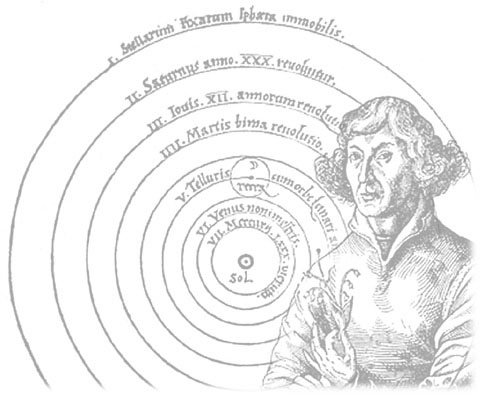
One of their favorites and mine is that well-known Polish astronomer Copernicus. 500 years ago he spent his life watching the stars trying to understand what was going on in this big crazy world. My sixth graders love it when I tell them that the world is crazy and we’re all just trying to understand it…. Copernicus, me and them in the same boat of having no idea what is going on. After years of dedicated watching, Copernicus realized that the observations he was making about the heavens did not fit with story he had been taught about how the solar system worked.  For over 1000 years western culture had been sure that the earth stood still in the center of the solar system and the rest of the heavenly bodies moved around it. But Copernicus’ data just wouldn’t fit that model. He had to change his story to make sense of his observations.

He had to change his story to make sense of his observations. I probably said that 25 times this week and at some point it dawned on me – I’m not just talking about astronomy, or science even. When Copernicus realized that his new information didn’t fit this old story he most likely felt the excitement of discovery but I suspect he also felt confused, insecure, anxious and maybe even more intense emotions like fear, dread, sadness or grief. Or maybe I’m just projecting.

We have to change our story to make sense of our observations. We tell ourselves lots of stories about how the world works – that the earth stands still, that God created heaven and earth in 6 days, that those people are taking our jobs, that that person will always act like this, or I will always do this or someday my prince will come. So many of these stories were built on outdated information but humans are meaning making machines and we hold onto our narratives like a drowning man, even when we know how to swim.

We have to change our story to make sense of our new observations. Hah, if only it were so easy. The child psychologist Piaget recognized that when humans get new information they can either ignore it, assimilate it seamlessly into their old story or reshape their understanding. Fundamentalists, hack scientists and addicts of all kinds are prime examples of the ignoring strategy, but we are all guilty. Piaget called the reshaping strategy disequilibrium, recognizing how uncomfortable and complex this process is.

Disequilibrium. Yeah, I know about that. Feeling like the ground is shifting under your feet. Like nothing makes sense anymore. Like all the old rules and old stories are a bunch of garbage and you are left with…. Well, you have no idea what you are left with. Anxiety and fear, sadness and grief are marking my disequilibrium. I see confusion and distress in the disequilibrium that my students are going through – because what is middle school if not a time when you are learning new things that don’t make sense in your old world order. Their bodies are changing, their brains are changing, their social networks are changing and nothing makes sense anymore. Yep, I know all about disequilibrium.

Piaget says that disequilibrium is a motivator for intellectual growth and creating schema, understandings, that are ever more adequate for dealing with reality. The astronomers we studied eventually came to a schema about the solar system that has allowed us to send men to the moon and probes to the worlds throughout our solar system. I have faith that my 6th graders will some day be generally functional adults and I’m sure I will come to an “ever more adequate schema” though I have no idea what that will look like. And none of these disequilibrium events are easy or comfortable. But as my Zen Buddhist friend says, with that very serious look Zen Buddhists so often have – what’s wrong with being uncomfortable? You just want to tell them to shut it, but he’s probably right.

I have to change my story to make sense of my observations. I’m anxious, uncomfortable, upset scared and sad these days. I’m in a state of disequilibrium. I’m not miserable, though… a new thing is rising or else I would still be happy in my old understanding. Its hard, it’s not fun, there are a lot of tears. But I guess one of those stories that doesn’t really work is the one that says life will be simple, comfortable and pleasant at all times.

Monday, June 24, 2013

Practicing Community

Mother's Moon

**** **** **** **** **** **** ****
 
This piece was written and presented as a "First Word" at my Quaker meeting. A First Word is a time to share with the community how god moves in your life so that we may more fully understand god's workings in the world. 
 
This is a topic I have been mulling over since at least last October (this post is what came out of those initial mullings) but between the time I agreed to give a First Word and the time I actually did get a chance to speak my life got turned pretty much on it's head. I contracted a serious bacterial infection in my ankle that landed me in the hospital for seven days, not walking for another week and still managing the physical and emotional recovery a month later. As I came through that trauma I realized I hadn't written out my thoughts and wondered if this was really what I wanted to speak about. I worried for a bit as I tried mightily to get thoughts to paper but then remembered - hey, I'm a Quaker. Words will come as words are meant to come. I got something down and trusted that the message that actually got shared would be the right message for the moment. 

What I present here is mostly "what I got down." I edited it lightly post ipso facto, but those of you who were in Meeting that morning will have to remember the sparkle as you saw it. 

*** *** ***
 
As much as we instant gratification, 21st century technology natives hate to admit it, it turns out, you gotta practice to get good at something. I was on a kickball team last spring and we lost every game we played. We had fun, but no one got any better at kicking or catching because we never practiced. I failed calculus three times in college before I figured out that doing the homework was the way to go. It helped that that last teacher was easy on the eyes, but the real key to success was practicing the work every day. Anything we want to get better at requires practice, from Stephen King writing every morning to things like friendship and relationships. I watch kids practice relationship with every awkward embrace in a high school hallway and every timid “can I play?” at day camp. 
 
Edward Hick's Peaceable Kingdom
Here at West Hills we do a lot of practicing, too; practicing how to be a community. Living in community with other people is hard, way harder than kickball and so the practice is that much more intense. We practice living in community with each birthday song and potluck, every dinner group and play date. I see us practicing the harder work of being vulnerable with each sharing of genuine joy or deep scary concern and I see us practicing caring for each other with every word of support or note of condolence. As a Quaker community we have a whole special set of skills to practice, from listening inwardly and outwardly in Meetings for Worship to learning to see that of god in every person. We practice discernment together and practice waiting for ways to open to lead us to win-win-win solutions. These are important skills that, through developing and practicing here, we have the opportunity to share with other communities we belong to. 
 
All this practice has paid off in my life. In recent hard times I have felt both the comforting refuge of a caring community and applied skills practiced here to other communities I am a part of. When I was in those dark days of finishing a master’s in teaching program I felt the support coming from this community and wondered why my group of girlfriends wasn’t doing the same for me. When I realized that this community includes explicit times to share concerns and encourages each other explicitly to meet each other’s expressed needs I was able to help my friends know what I needed. They stepped up and we grew closer as a community.
 
Recent events have tested my ability to give and receive support from my community again. Being in the hospital was overwhelmingly difficult in many ways. I have gotten tangible, physical support from members of this community as well as a flood of prayers, well wishes and more cat videos than I can shake a stick at. More importantly, though, this community has been a place for me to practiced asking for and receiving and giving support of all kinds so that when I really needed it, I could figure out what to ask for and how to ask it.
 
West Hills Friends is a community of peacemakers
A trusting, genuine, loving community is a basic human need that is hard to come by in our time and place in history. Here at West Hills Friends we have a special jewel worth nurturing and learning from. We have done the practice, put in the work to develop a community that, through our trusting relationships with each other and with the Spirit, allows people to be vulnerable, ask for help, receive help and celebrate joys. We have fun with each other, we do hard work together and we take care of each other. It is a safe and caring refuge for each of us in a world that can be scary, painful or cold. But it is also a training field for us to learn and practice skills we can bring to our other communities, our families, our work places, our other groups of friends. Learning to listen, to wait, to explicitly ask for help and cheerfully give what help we can, to subvert the power hierarchies of the culture by valuing people and relationships. These skills that we practice here at West Hills can be applied in all aspects of our lives. 
 
We have a lot to offer the world here, and the only way to get good enough to get noticed is to keep practicing. 
 
**** **** **** **** **** **** ****

Note: The topic of this post does not have much to do with the Mother's Moon. It's really much more a Journey Moon or a Father's Moon topic. But the fact of the matter is it got written and spoken during the Mother's Moon so that's where it falls in the blog. Things are getting a bit wacky around here. To understand the Mother's Moon energies, check out past posts, please.

Mother's Moon 2012: Nothing but Good Can Come of This 

Mother's Moon 2011: Freedom, July and Krishna and the Gopis


Mother's Moon 2009: Gifts from the Mother